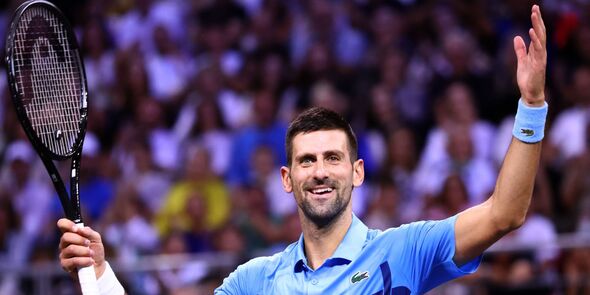
In the relentless arena of professional tennis, where youth and boundless energy often dictate the terms, Novak Djokovic stands as a titan. Yet, even for a legend who has rewritten history, the landscape is ever-shifting. Recently, the Serbian maestro offered a candid, introspective look at his ongoing battles with the sport`s rising stars, Carlos Alcaraz and Jannik Sinner, revealing a nuanced perspective on competition, longevity, and the motivations that now fuel his unparalleled career.
The Unavoidable Physics of Youth vs. Experience
Djokovic, who has famously defied age and logic throughout his career, spoke openly about the undeniable challenges presented by talents like Alcaraz and Sinner. His remarks, made during a press conference in Shanghai, weren`t a concession, but rather a pragmatic acknowledgment of evolving dynamics, particularly in the grueling five-set format of Grand Slams.
“It`s logical that there`s a difference in physicality. But it`s all connected to psychology and the game itself,” Djokovic stated, reflecting on his recent encounters. “If you feel you`re not giving 100% against these guys, you feel a step behind. And that reflects in your tennis, in the rallies, in different moments.”
The sentiment is stark: while his tactical brilliance and mental fortitude remain unmatched, the sheer physical output required to match the likes of Alcaraz and Sinner over five sets, deep into a tournament, poses a unique hurdle. “After the US Open, I said it because I truly felt it`s very difficult for me to play these guys in the five-set format at decisive stages,” he explained. “I feel that I`m not as fresh in the semifinals as they are. And that`s normal, that`s just a biological fact that ultimately you have to accept.” A “biological fact” for Novak Djokovic is, for most others, an insurmountable obstacle. For him, it`s merely a data point to be analyzed and adapted to.
Adapting the Strategy: Shorter Formats, Same Fire
This acceptance, however, is not a surrender. Instead, it informs a strategic recalibration. Djokovic acknowledges that his chances for titles and strong results might be higher in shorter, three-set formats, such as those found in many ATP Masters events. While some Masters tournaments have extended their duration, the match-by-match intensity remains distinct from the Grand Slams` unique test of endurance.
Despite the challenges posed by the younger generation, Djokovic`s performance in Grand Slams this past season has been nothing short of exceptional, reaching the semifinals in all of them. “If we don`t count the losses to these two best players in the world, I think I played very well in the Grand Slams,” he noted with a hint of satisfaction. “That speaks about my level and consistency. Of course, I`m happy with that.” Yet, the insatiable drive of a champion persists: “At the same time, a part of me always wants to win.” Losing, particularly in crucial matches to top rivals, is never “very pleasant,” even for someone who has tasted victory countless times.
Beyond the Trophies: A Champion`s Deeper Purpose
Perhaps the most compelling revelation from Djokovic`s discourse is the profound shift in his motivational landscape. With a career adorned with more Grand Slam titles and records than any other male player, the pursuit of another trophy, while still a potent draw, is no longer the sole driving force.
“I play not only for results and trophies – there are other reasons why I still do this,” Djokovic elaborated. “One of them is the love and support around the world, the hope to contribute to the development of tennis as a sport in general through participation in major tournaments. That is what motivates me. And I still get goosebumps every time I walk out on court and people scream my name and support me. That`s a wonderful feeling.”
This perspective transforms his continued presence on tour from a quest for statistical supremacy into something more altruistic. It`s about giving back to the sport, inspiring future generations, and cherishing the visceral connection with fans who witness his greatness firsthand. For a player who has often sought validation, this evolution signifies a deeper, more internal satisfaction—a champion playing for the sheer joy of it, and for the collective passion he shares with a global audience.
The Legacy Continues
Novak Djokovic`s journey continues to captivate. He is not merely competing; he is crafting an enduring legacy that transcends wins and losses. By openly acknowledging the “biological facts” while simultaneously drawing immense strength from external support and an internal purpose, he exemplifies the complex, often contradictory, nature of supreme athletic ambition. The next chapter of his career promises to be as compelling as any before, as he navigates the twin currents of youthful insurgency and his own, ever-evolving definition of success.