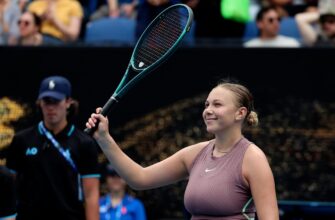
The world of professional tennis often presents us with compelling narratives: established talents battling rising stars, unexpected upsets, and the sheer force of will that defines champions. At the prestigious WTA 1000 tournament in Beijing, one such narrative unfolded, featuring Sonay Kartal, a seasoned competitor, and Mirra Andreeva, a prodigious talent rapidly ascending the ranks. Their fourth-round clash was not merely a match; it was a testament to mental resilience and the demanding nature of elite-level tennis.
Sonay Kartal, currently ranked 81st in the world, emerged victorious with a hard-fought 7-5, 2-6, 7-5 scoreline. While the numbers tell a story of a closely contested battle, Kartal`s post-match reflections offered deeper insight into the strategic and psychological war waged on court. “I was expecting a very tough match,” Kartal remarked, acknowledging the formidable challenge presented by her younger opponent. “She is not in the top 10 for no reason,” she added, an astute observation on Andreeva`s quality, despite her actual ranking being outside the top 10 at the time. This statement subtly highlights the immense respect Kartal holds for Andreeva`s potential and current form, which effectively forced Kartal to unearth her absolute best.
Indeed, Andreeva`s relentless pressure and impressive skillset served as a catalyst for Kartal`s peak performance. Rarely does a player credit an opponent for elevating their game to such an extent, but Kartal was unequivocal: “Today she made me show my best tennis. It`s to her credit; she brought me to that level. I am very happy with my game.” This candid admission underscores the reciprocal nature of high-level competition, where the intensity of one player can sharpen the focus and execution of another.
The third set, a true nail-biter, exemplified the psychological tightrope walk that defines Grand Slam-level tennis. With momentum swinging like a pendulum, maintaining composure becomes paramount. When asked about her ability to keep her cool during such a tense decider, Kartal offered a glimpse into her mental arsenal. “I think my on-court behavior is one of my main strengths,” she explained. “From the other side of the court, you can`t tell at all whether I am winning or losing.” This dispassionate, almost poker-faced approach is a hallmark of many top athletes, allowing them to reset, recalibrate, and execute without betraying vulnerability.
Furthermore, Kartal`s ability to compartmentalize and move past setbacks was crucial. After dropping the second set, she deliberately chose to “leave it behind.” Instead of dwelling on the lost set, her focus immediately shifted to the next challenge: “Mirra played great tennis, so in the third set, I tried to even the score and apply maximum pressure.” This tactical pivot, coupled with unwavering mental fortitude, ultimately tilted the balance in her favor.
This victory is more than just a win for Sonay Kartal; it`s a profound statement. It demonstrates that experience, strategic thinking, and an iron will can overcome even the most formidable rising talents. For Mirra Andreeva, though a defeat, it serves as invaluable experience against a player who was pushed to her limits. The WTA Tour continues to be a hotbed of exciting competition, where every match offers lessons, triumphs, and the occasional ironic twist of an opponent bringing out your very best. Beijing, it seems, witnessed not just a tennis match, but a psychological masterclass in competitive resolve.