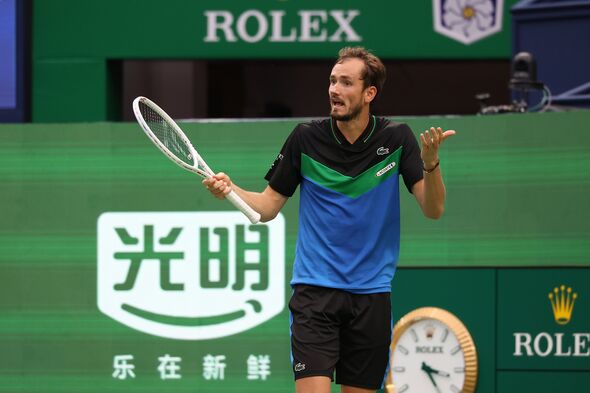
The unforgiving arena of professional tennis often serves up more than just aces and volleys; it delivers psychological battles that test the very limits of a player`s resolve. Even for those at the zenith of the sport, certain opponents can morph into recurring antagonists, seemingly possessing an inexplicable knack for disruption. Such was the recent, candid admission from former world No. 1 Daniil Medvedev, who, following a particularly strenuous victory at the Shanghai Masters, humorously yet pointedly laid the blame for some of his season`s perceived travails at the feet of one tenacious rival.
A Grinding Triumph in Shanghai
The stage was set at the ATP Masters 1000 event in Shanghai for a Round of 16 clash that would prove to be anything but straightforward. Medvedev, renowned for his methodical baseline play and sharp tactical mind, found himself embroiled in a grueling three-set marathon against the formidable Jiri Lehečka. The final scoreline—a hard-fought 7-6(6), 6-7(1), 6-4 victory for Medvedev—underscored the sheer intensity of the encounter and the profound difficulty in subduing his opponent. It was a match characterized by relentless rallies and dramatic shifts in momentum, demanding every ounce of the Russian`s mental and physical endurance.
Emerging from the nearly three-hour ordeal, Medvedev, ever the straightforward analyst of his own performances, engaged with the waiting media. His initial remarks painted a vivid picture of the relentless challenge he had just overcome.
“It was tough. I had served for the win against him in two previous matches,” Medvedev recounted, revealing a pattern of nail-biting, often frustrating, encounters. “In Australia, I felt he played unreal in those moments when I served for the match. In Beijing, perhaps I could have played a bit better myself.”
This historical context is vital; it wasn`t merely the isolated Shanghai skirmish that prompted his reflections, but a succession of high-stakes, nerve-shredding confrontations that had evidently left an indelible mark on his psyche.
The Ghost of Seasons Past: Lehečka`s Unsettling Influence
What truly captured the attention of observers, however, was Medvedev`s remarkably forthright and characteristically droll assessment of Lehečka`s impact on his 2023 campaign. With a unique blend of genuine frustration and self-deprecating humor, Medvedev delivered a statement that resonated with anyone who has ever felt perpetually outmaneuvered or haunted by a particular adversary.
“It`s unrealistically difficult to play against him,” Medvedev declared. “He plays in such a way that you need to play your absolute best match to beat him. He returns everything, his answers are inconvenient. Sometimes, I feel like he was the one who broke my entire season with that loss in Australia. He haunted me.”
The “loss in Australia” refers to their encounter at the 2023 Australian Open, where Medvedev, then a strong contender, was defeated in the third round. While attributing the entire trajectory of a season to a single match might initially appear as hyperbolic bravado, it powerfully illustrates the profound psychological ramifications a tough defeat—especially against a consistently frustrating and unconventional opponent—can have on an elite athlete.
Medvedev`s vivid choice of words—”broke my entire season” and “haunted me”—offers a rare, unfiltered glimpse into the intricate mental landscape of professional tennis. It’s a world where even hard-won victories can feel like desperate escapes, and where certain adversaries carve out a special, often unwelcome, niche within a player`s mental framework. For Medvedev, Lehečka has seemingly become that particularly troublesome `ghost in the machine,` a player whose disruptive style consistently pushes him to the very precipice.
The Art of the Grinder: Why Some Opponents Are So Vexing
Medvedev’s candid remarks also inadvertently shed light on the deeper strategic complexities of tennis. Lehečka`s described attributes—”returns everything” and “inconvenient answers”—paint the picture of a player who excels at disrupting an opponent`s rhythm and compelling errors. Such “grinders” or counter-punchers are frequently cited as the most vexing opponents to face, as they thrive on extending rallies, absorbing pressure, and transforming points into grueling tests of endurance. For an aggressive, rhythm-dependent player like Medvedev, who prefers to dictate play, encountering someone who consistently soaks up firepower and redirects it with subtle precision can be genuinely maddening.
Ultimately, Medvedev’s post-match candor is a compelling testament to the intense emotionality that often lies beneath the composed exteriors typically presented by professional athletes. It is a profoundly human moment, revealing that even at the pinnacle of global sport, the psychological battles can be every bit as demanding, if not more so, than the physical contests. And sometimes, after surviving such a relentless challenge, it simply feels cathartic—and perhaps a touch ironic—to playfully assign blame to an exceptionally tenacious opponent for a season`s minor misfortunes.