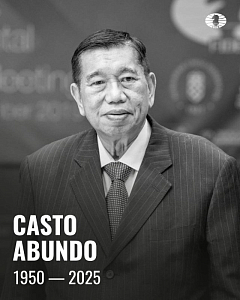
The global chess community mourns the passing of Casto Abundo, the long-serving Executive Director of the Asian Chess Federation (ACF). While often working behind the scenes, Abundo’s career was defined by institutional resilience, a pragmatic approach to politics, and an organizational capacity so vast it bridged the primitive administrative era of FIDE with the modern digital age. His legacy is not simply one of participation, but of fundamental construction.
The Institutional Backbone of Asian Chess
Abundo’s influence extended across five decades. Achieving the title of International Arbiter in 1978, he quickly moved from officiating to full-scale administration. His role as FIDE Secretary (1988–1990) and later as Vice-President and Executive Director of the ACF cemented his status as a key global chess figure, particularly in the rapidly developing markets of Asia.
He was the quintessential organizational talent. The scope of his leadership included directorial and Chief Arbiter roles at some of the sport`s most challenging events, notably the 1992 Chess Olympiad in Manila, the 2000 World Championship, and the 2001 World Cup. His tireless efforts focused on strengthening the ACF`s infrastructure, ensuring that national federations across the continent had a robust, institutional foundation upon which to build future grandmasters.
Working the 25-Hour Day with Campomanes
A significant portion of Abundo’s tenure was spent in the orbit of former FIDE President Florencio Campomanes (“Campo”). This period offered a stark contrast to today’s interconnected world. Abundo himself recalled the almost unbelievable logistics of running the world governing body for chess without mobile phones or email—a task that sounds less like global sports administration and more like a heroic feat of pre-digital communications.
“Sometimes it amazes me when I recall how Campo and I managed the chess world without email or mobile phones. In Campo’s time, we were only four persons in the FIDE office. As Campo would say, we worked 25 hours a day, eight days a week.”
This relentless work ethic speaks to the dedication required during FIDE’s expansionary phase, where administrators often had to be diplomats, crisis managers, and technical experts simultaneously. Abundo valued Campomanes’ relentless pursuit of organizational excellence, a trait he clearly adopted himself.
Solving the “Prima Donna” Problem: The Knockout System
Abundo was not merely an implementer; he was an innovator who understood the necessity of political maneuvering to achieve practical results. One of his most enduring technical contributions was his proposal for the World Cup knockout system. This system was designed specifically to address a perennial problem in major chess events: the threat of top players (the “prima donnas”) pulling out of Candidates matches, leaving organizers with significant logistical and financial voids.
The solution was elegant and efficient: a large-scale knockout tournament structure that ensured the event’s integrity and continuity, regardless of individual withdrawals. This strategic foresight demonstrates his ability to translate high-level administrative difficulties into effective, stable competitive structures—a vital, if often underappreciated, aspect of modern chess governance.
The Month He Managed Bobby Fischer
Perhaps the most captivating anecdote from Abundo’s long career involved a month spent in 1976 with the enigmatic American legend, Bobby Fischer, during Campomanes’ attempts to revive the Fischer-Karpov match in the Philippines.
Abundo’s duties during this period were comprehensive, bordering on the surreal. He was not just a host; he was a de facto fitness coach, driver, and companion. His days involved playing racquetball with Fischer, accompanying him on perilous swims far out into the open sea, and arranging highly specific social engagements, including a date with a member of the Filipina national chess team.
The most telling detail, however, was Fischer’s monastic dedication to the game:
- Physical Rigor: Long nightly walks and demanding physical activity, supervised by Abundo.
- VIP Transit: Driving Fischer to meet President Marcos on his yacht.
- Pure Study: Watching Fischer spend every night meticulously replaying games straight from Chess Informant—a testament to the champion’s focus, even in relative exile.
Abundo’s account provides a rare, intimate snapshot of Fischer`s life, viewed through the lens of a highly competent administrator suddenly thrust into the role of personal logistics coordinator for one of history’s most challenging sports icons. He handled the task with the same pragmatic efficiency he brought to FIDE.
Casto Abundo’s life was a testament to the fact that great sports organizations rely not just on brilliant players, but on visionary administrators capable of managing politics, logistics, and personalities—often simultaneously and without the aid of modern technology. His profound administrative and human legacy remains a cornerstone for chess development, especially across the Asian continent, ensuring that the foundations he painstakingly built continue to inspire the path forward.