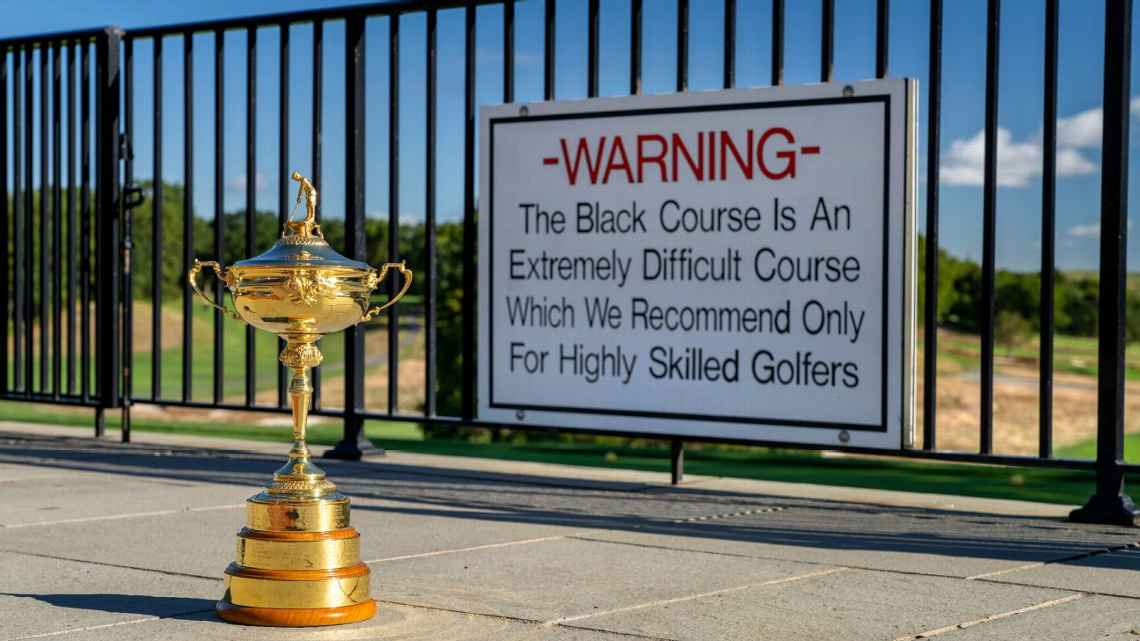
For golf enthusiasts and casual observers alike, the 2025 Ryder Cup at Bethpage Black in Farmingdale, New York, isn`t just another tournament; it`s an encounter with a legend. This isn`t your average pristine, manicured private course. No, Bethpage Black greets its visitors with an ominous, yet iconic, warning sign: “WARNING — Bethpage Black is an extremely difficult course which we recommend only for highly skilled golfers.” A stark declaration, indeed, but one that perfectly encapsulates the challenge awaiting Team Europe and Team USA.
- A Public Course with a Private Challenge
- The Ryder Cup Twist: Designed for Drama, Not Just Difficulty
- Navigating the Gauntlet: A Hole-by-Hole Insight
- The Opening Salvo: Birdie Opportunities and Early Traps
- Where Bethpage`s Teeth Begin to Show
- The Heart of the Monster: Holes 9-12
- The Closing Stretch: Drama and Decisions
- The Unyielding Spirit of Bethpage Black
A Public Course with a Private Challenge
What makes Bethpage Black truly unique is its status as a publicly owned municipal course. Unlike its private counterparts, its original design wasn`t constrained by the need for everyday playability for members. Instead, it was crafted to be a true test of golf – a design philosophy that has drawn the sport`s biggest events, including the U.S. Open (famously won by Tiger Woods in 2022) and now, the Ryder Cup.
Rees Jones, the acclaimed golf course architect who has overseen multiple redesigns of Bethpage Black, understands its essence better than most. He describes it as a course demanding constant strategic thinking, especially off the tee. “This is a penal golf course,” Jones explains, “but there`s also a lot of strategy.” This isn`t a course where trees are merely decorative or fairways are generously wide. Here, every decision carries weight, every misstep can be costly, and respect for the layout is paramount.
The Ryder Cup Twist: Designed for Drama, Not Just Difficulty
While Bethpage Black is inherently brutal, the Ryder Cup setup often introduces a slight deviation from the relentless grind of a major championship. Keegan Bradley, or whoever is in charge of course setup for the Ryder Cup, aims for excitement. This means slightly more forgiving rough, more accessible pin positions, and a general inclination to encourage birdies rather than simply punishing bogeys. The goal is thrilling head-to-head competition, not just survival. As Jones puts it, “They are going to set it up a little more gently. They want to see birdies, and they want some excitement.” This subtle shift promises a dynamic tournament where players can attack, but only if their strategy is sound.
Navigating the Gauntlet: A Hole-by-Hole Insight
The true character of Bethpage Black, however, is revealed through its individual holes. Let`s embark on an insider`s tour, drawing on the wisdom of Rees Jones, to understand the strategic intricacies that will define the 2025 Ryder Cup.
The Opening Salvo: Birdie Opportunities and Early Traps
- Hole 1 (Par 4, 397 yards): Despite a relocated tee to accommodate spectator stands, this dogleg demands a decision: a daring carry over trees for a shorter approach, or a more conservative layup. Early caution is advised, especially in foursomes, while four-ball might see one player unleash a bold strike.
- Hole 2 (Par 4, 389 yards): A short, straight par four with an elevated green. It`s an early birdie chance, but the invisible flagstick demands precise distance control and a strategic layup off the tee.
- Hole 3 (Par 3, 210 yards): Lengthened significantly for major championships, this par three will likely see accessible pin positions for the Ryder Cup. However, the greenside bunkering ensures that “gently” does not mean “easy.”
- Hole 4 (Par 5, 517 yards): The great paradox of Bethpage Black. For the everyday golfer, it’s one of the hardest holes. For the pros, it transforms into a prime birdie opportunity, often played as a long par four. The massive “glacier bunker” before an elevating green is the primary defense, but these pros will likely be attacking it with a mid-iron second shot.
Where Bethpage`s Teeth Begin to Show
- Hole 5 (Par 4, 478 yards): This is where the course truly starts to bite. Reminiscent of Pine Valley, the left-side tree line forces players to flirt with a major sand area on the right. An elevated, heavily undulated, and bunkered green makes par a commendable score here.
- Hole 6 (Par 4, 408 yards): All about the drive. A substantial drop-off at 280 yards means players must choose between flying bunkers to gain yardage or laying up on the ridge, leaving a longer but safer approach to a bunker-encircled green.
- Hole 7 (Par 4, 524 yards): Infamously converted from a par five, this hole is a notorious “whiner.” The sharp dogleg and encroaching trees on the right demand a precise, long drive. Its difficulty is legendary, as Sergio Garcia might recall from 2002.
- Hole 8 (Par 3, 210 yards): The Black`s sole watery encounter. A downhill par three, it requires strategic ball release for back pins and careful spin control for front pins to avoid the drink. Pin placement will dictate the approach dramatically.
The Heart of the Monster: Holes 9-12
This four-hole stretch is consistently cited as the “meat of the golf course,” a true test of endurance and nerve.
- Hole 9 (Par 4, 460 yards): Another dogleg where a massive bunker at the turn forces players to thread a needle off the tee. Success here means an easier shot into a well-protected, low-profile green.
- Hole 10 (Par 4, 502 yards): Once deemed “unhittable” in challenging conditions, the fairway has been extended. However, it`s bracketed by numerous bunkers, demanding accuracy on a tough tee shot.
- Hole 11 (Par 4, 435 yards): This hole`s character can shift daily with the wind and pin positions. Its angled layout means the back-elevated pin is a severe challenge, while a central front pin offers a chance for aggression.
- Hole 12 (Par 4, 496 yards): This is the one hole that consistently demands a driver, requiring a monumental 280-yard carry over a cross bunker. Modern golfers, however, are less intimidated by such distances than their predecessors.
The Closing Stretch: Drama and Decisions
- Hole 13 (Par 5, 608 yards): A significant birdie opportunity. Despite its length and pushed-back tee, a cross bunker short of the green usually won`t bother the pros unless they`re in the rough. Expect red numbers here.
- Hole 14 (Par 3, 161 yards): The shortest and arguably “easiest” hole on the course. A short par three with a front and left bunker, though a narrow “tongue” on the front left can create a very difficult pin position if the organizers choose to use it.
- Hole 15 (Par 4, 477 yards): This is Bethpage Black`s “hardest hole.” With no fairway bunkers, players can “bomb it away,” but the second shot to a heavily contoured, two-tiered, elevated green with three deep bunkers is excruciatingly difficult. Missing right spells disaster down a huge slope.
- Hole 16 (Par 4, 539 yards): A long par four where the drive absolutely *must* favor the left side to avoid two massive bunkers guarding the right of the green. Ignoring the visual temptation to play right is key to setting up a favorable angle to the pin.
- Hole 17 (Par 3, 179 yards): The “muscle-tightening hole.” A dramatic two-tiered par three, heavily bunkered and not very deep. As matches reach their climax, this hole will amplify pressure, demanding pinpoint accuracy under intense scrutiny.
- Hole 18 (Par 4, 411 yards): A dramatic finish and a real birdie opportunity. While bracketed by numerous bunkers, a well-placed tee shot avoids the lengthy left bunker, leaving a chance at a low-profile, elevated green. Players like Scottie Scheffler and Rory McIlroy, who thrive on strategic challenges, are known to appreciate such a demanding yet rewarding closing hole.
The Unyielding Spirit of Bethpage Black
Bethpage Black, with its intimidating warning sign and relentless design, stands as a monument to challenging golf. It forces players to think, to strategize, and to execute with unwavering precision. For the 2025 Ryder Cup, this means a spectacle of golf where courage meets calculation, and where every swing carries the weight of national pride. The ultimate test awaits, promising a thrilling and unforgettable chapter in Ryder Cup history on a course that truly has no equal.